


Advil safety and tolerability

Advil: a proven safety profile for a wide range of patients*
OTC doses of Advil have a low risk of cardiovascular, renal, or hepatic adverse events.1,2 †
*When used as directed.†Studies evaluating the product’s efficacy and tolerability/safety.
Comprehensive overview of ibuprofen’s safety profile
Ibuprofen, the primary ingredient in Advil, has been used as a first line, nonprescription NDAID for over 40 years. Decades of OTC use and clinical trials have supported ibuprofen’s tolerability and favorable safety profile.
Healthcare providers should feel confident in recommending Advil pain relief products to their patients.
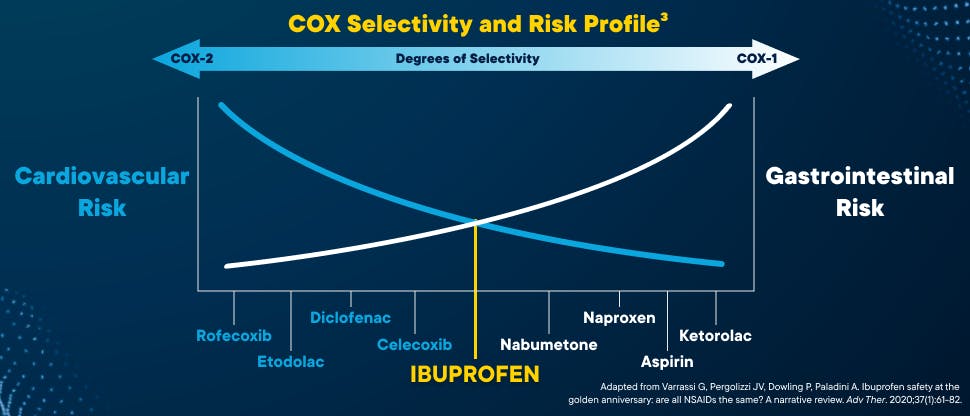
Not all NSAIDs are the same: Advil has a balanced selectivity profile targeting COX 1 and COX 2 enzymes3
Greater balance of selectivity helps balance risk
The medicine in Advil is one of the most centrally balanced between COX 1 and COX 2 selectivity among NSAIDs,3 supporting its good tolerability with patients.
Pharmacokinetic data
The medicine in Advil is highly protein bound and rapidly metabolized, minimizing systemic exposure:2
- Rapidly absorbed and distributed throughout the body
- Rapid onset of efficacy—less than 30 minutes
- Results in lower blood concentration levels while delivering relief
- Has a short half-life so it’s rapidly cleared from the body
- Generally does not accumulate over time
- Metabolites do not cause toxicity
Advil has 40+ years of clinical studies & real-world evidence confirming its safety profile
COX inhibitors, like NSAIDs, are widely used due to their anti-inflammatory and antipyretic properties and are indicated for mild pain by the WHO.7
Recommend Advil—proven effective pain relief with a favorable safety profile.
Advil has 40+ years of clinical studies & real-world evidence confirming its safety profile.
-
Cardiovascular safety profile
![Image to show the cardiovascular system]()
Cardiovascular safety profile
Recent data relating to hypertension
The PATH-BP trial was a double-blind, placebo-controlled crossover study regarding the effect of acetaminophen use on blood pressure in patients with hypertension5
According to the authors, acetaminophen, at OTC dosing levels, statistically significantly increased systolic blood pressure by 4.7 mmHg versus placebo over a 2-week period5
Advil, with a proven safety profile over a 40-year brand history, has a similar cardiovascular safety profile to other products in the NSAID class.*
Low probability of cardiovascular events
Advil, with a proven safety profile over a 40-year brand history, has a similar cardiovascular safety profile to other products in the NSAID class.*
Low probability of cardiovascular events
- OTC ibuprofen poses no greater risk of acute myocardial infarction compared to other NSAIDs, acetaminophen, or placebo, based on its robust clinical study data†2,6
- In a case-control study, OTC ibuprofen had similar cardiovascular risks to OTC naproxen2
- In clinical studies, OTC Ibuprofen poses no greater risk of stroke compared to other NSAIDs‡2
Ibuprofen and cardiovascular safety information
NSAIDs, except aspirin, increase the risk of heart attack, heart failure, and stroke. These can be fatal. The risk is higher if you use more than directed or for longer than directed.
According to the Advil Drug Facts, patients should not use ibuprofen right before or after heart surgery. Patients are directed to ask a doctor before use if they have high blood pressure, heart disease, or have had a stroke.
Ask a doctor or pharmacist before use if you are under a doctor's care for any serious condition; taking aspirin for heart attack or stroke, because ibuprofen may decrease this benefit of aspirin; taking any other drug.
Patients should stop use and ask a doctor if:
- They have symptoms of heart problems or stroke, including:
- Chest pain
- Trouble breathing
- Weakness in one part or side of the body
- Slurred speech
- Leg swelling
- Any new symptoms appear
*When used as directed.†Relative to non-use.‡Naproxen and celecoxib.
-
Renal safety profile
![Image to show the renal system]()
Renal safety profile
Low probability of renal events with OTC use of ibuprofen, based on clinical studies2*
- When taking Advil as directed, clinical studies showed that the risk of kidney-related side effects was low2,4
- Clinical data show that taking Advil as directed at OTC dosing for less than 10 days is associated with a low risk of kidney-related side effects4
Ibuprofen and renal safety information
The Advil Drug Facts recommend that patients with kidney disease or those who are taking a diuretic should consult a doctor before use.
*When used as directed.
-
Hepatic safety profile
![Image to show the hepatic system]()
Hepatic safety profile
Low risk of hepatotoxicity with Advil*
- Clinical data support that there is a low risk of hepatotoxicity with OTC ibuprofen use2
- Ibuprofen is less likely than acetaminophen to produce hepatic injury in patients2
Ibuprofen and hepatic safety information
The Advil Drug Facts recommend that patients with liver cirrhosis should consult a doctor before use.
*When used as directed
-
Gastrointestinal safety profile
![Image to show the gastrointestinal system]()
Gastrointestinal safety profile
Ibuprofen has generally good gastrointestinal (GI) tolerability based on clinical study data when used at dosages of 800 mg to 1200 mg per day (OTC dose)4*
- Clinical studies have shown that when OTC ibuprofen is taken as directed by the label for no longer than 10 days, there is a low increased risk of stomach complaints or bleeding4
Ibuprofen and GI safety information
As indicated in the Advil Drug Facts, ibuprofen, like all NSAIDs, may cause severe stomach bleeding. The chance is higher if you:
- Have 3 or more alcoholic drinks every day while using this product
- Are aged 60 years or older
- Take a blood thinning (anticoagulant) or steroid drug
- Take other drugs containing prescription or nonprescription NSAIDs (aspirin, ibuprofen, naproxen, or others)
- Have had stomach ulcers or bleeding problems
- Take more or for a longer time than directed
*When used as directed.




Ibuprofen vs. acetaminophen for pain
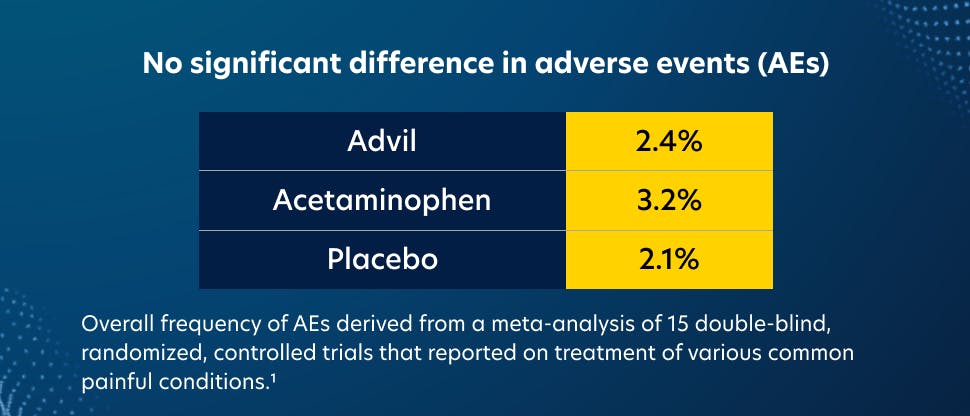
Favorable overall safety profile
Results of a meta-analysis of 15 double-blind, randomized, placebo-controlled clinical studies:
No significant differences in AEs among or between ibuprofen, acetaminophen, or placebo-treated patients1,4*
- Clinical studies show no significant differences were observed in overall frequency of AEs between the medicine in Advil and Tylenol, both of which had rates similar to placebo
- AEs with OTC doses of Advil were generally present at similar rates as placebo†
Additionally, unlike prescription doses of ibuprofen, OTC doses of Advil, when taken as directed, have a low risk for occurrence of AEs across all body systems2
*When used as directed.†AE rates increased with higher dosing similar to Rx.
Safety comparison: ibuprofen vs. acetaminophen
| System | Ibuprofen (NSAID) | Acetaminophen |
| Cardiovascular | Increased risk of myocardial infarction, stroke and heart failure at high doses or with chronic use.10 | Some studies suggest mild blood pressure elevation and cardiovascular disease with frequent use of formulations containing sodium.11 |
| Renal | Prostaglandin inhibition can reduce blood flow to the kidneys; chronic use may accelerate kidney disease12 | Generally safe at OTC doses, chronic high-dose use or overdose may lead to acute kidney injury13 |
| Hepatic | Generally safe at normal doses, hepatoxicity very uncommon14 | Hepatoxicity is dose-dependent; overdose is the leading cause of acute liver failure in many countries15 |
| Gastrointestinal | Increased risk of gastritis, ulcers and GI bleeding. Risk increases with dosage, age and whether patient is taking anticoagulants. Recommend PPIs as co-therapy.16 | Minimal GI irritation at normal doses. Risk increases with chronic high-dose use or combination with NSAIDs.17 |
| Pregnancy | Not recommended to be taken during pregnancy, especially after 20+ weeks. May lead to complications for the fetus and parent like birth defects and low birth weight18 | The American College of Obstetricians & Gynecologists supports the use of acetaminophen as an analgesic during pregnancy when taken as needed and with the consultation of a healthcare provider19 |
| Lactation | Evidence suggests that mothers can take proper doses of ibuprofen while breastfeeding 18 | As with other medications, trace amounts will appear in breast milk, but in smaller amounts than a standard infant dose. Expected to be well-tolerated during breastfeeding19 |
Safety perspective: ibuprofen combined use with acetaminophen
As ibuprofen and acetaminophen provide analgesia via different mechanisms within the body and are metabolized differently, using a multimodal form of analgesia that combines the popular OTC medications has proven effective in managing mild-to-moderate pain.8
FDA-approved combination analgesics that are available over the counter like Advil Dual Action have been shown to be safe and well-tolerated when used according to labeling. A study published in the Journal of Pain Research indicated that a combination of fixed dose acetaminophen and ibuprofen illustrated an excellent safety and tolerability profile, and there was no increase in incidence of adverse effects.9
Healthcare providers should stress the importance of not exceeding the recommended dosage, in order to avoid any AEs.
View the benefits
Advil Tablets
Experts and patients have trusted Advil for safe and effective pain relief for 40+ years.

Advil Liqui-Gels
Fast-acting formulation to relieve acute patient pain.

Advil Dual Action
Multi-modal formulation fights pain two ways.
Explore related content

An important clinical study
This double-blind, placebo-controlled, crossover study examined the effects of regular acetaminophen dosing on blood pressure in individuals with hypertension.

Patient samples for your practice
Help patients get clinically proven, safe pain relief with free samples.
