

Ibuprofen vs. Acetaminophen: A Practical, Evidence-Based Comparison for Clinicians

Ibuprofen (the active ingredient in Advil) and acetaminophen are among the most used analgesics and antipyretics worldwide. By comparing their mechanisms, efficacy by use case, and safety profiles, healthcare providers should feel confident when advising patients while remaining focused on safety.
Ibuprofen vs. Acetaminophen: Pharmacology & MOA
Ibuprofen
Ibuprofen is a traditional nonsteroidal anti-inflammatory drug (NSAID) widely used for its analgesic, anti-inflammatory, and antipyretic properties.1 The main mechanism of action of ibuprofen is the non-selective, reversible inhibition of the cyclooxygenase enzymes COX-1 and COX-2 at the site of injury or pain.1
This inhibitory mechanism is directly linked to decreased production and formation of prostaglandins, chemicals that enhance edema formation, increase vascular permeability, and promote leukocyte infiltration.1 Prostaglandins also reduce the threshold of nociceptor sensory neurons to stimulation. Ibuprofen exerts its anti-inflammatory and analgesic effects largely by inhibiting the formation of these prostanoids.1
In short, the MOA of ibuprofen lies in its ability to:1
- Inhibit COX enzymes, leading to decreased formation of chemicals responsible for causing pain, inflammation and fever
- Help reduce swelling, prevent fluid buildup, lower sensitivity to pain
- Block harmful immune responses like the release of free radicals or clumping of white blood cells
Acetaminophen
Acetaminophen is a non-opioid analgesic and antipyretic agent utilized for treating pain and fever. It is historically categorized along with nonsteroidal anti-inflammatory drugs (NSAIDs) due to its inhibition of certain cyclooxygenase (COX) pathways.2
Evidence suggests that acetaminophen primarily acts within the central nervous system (CNS). It is thought to reduce COX activity in the central nervous system (CNS), leading to decreased prostaglandin synthesis; however, its mechanism of action is not fully understood. This central inhibition is thought to account for its analgesic and antipyretic effects.2
However, it lacks peripheral anti-inflammatory effects; the effect of acetaminophen at the pain site is not thought to be responsible for relief from inflammation and localized pain relief. Instead, relief is mediated largely through central mechanisms—attenuation of pain signal transmission and modulation of nociceptive processing—rather than direct anti-inflammatory effects at the site of tissue injury.2
Clinical takeaway: When to choose ibuprofen vs. acetaminophen
- When inflammation is a prominent driver in pain (e.g., dental surgery, dysmenorrhea, arthritis, sprains and musculoskeletal issues), ibuprofen’s peripheral COX inhibition confers an advantage.
- Acetaminophen may be more helpful when anti-inflammatory action is unnecessary or NSAID risks are prohibitive.
Adult dosing guardrails for a typical adult outpatient
| Medication | Adult Dose |
| Ibuprofen1 |
|
| Acetaminophen2 |
|
Comparative Effectiveness by Use Case
Acute pain management.
- A 2020 study on the efficacy and safety of a fixed dose combination (FDC) of ibuprofen and acetaminophen in a 250/500 mg formulation indicated a rapid onset of action and a duration of pain relief for at least 8 hours.10 The American Dental Association recommends a FDC of ibuprofen and acetaminophen as first-line therapy for dental pain and toothache ahead of opioids. These results support a non-opioid first approach to acute musculoskeletal pain and postoperative dental pain.3,4
Inflammatory pain.
- Because of peripheral COX inhibition, ibuprofen generally outperforms acetaminophen when inflammation predominates.6
Noninflammatory mild–moderate pain or where NSAIDs are unsuitable.
- Acetaminophen may be preferred at therapeutic doses for its analgesic mechanisms on the CNS, provided liver risks are addressed.7
Safety profiles
Using ibuprofen and acetaminophen together
Multimodal analgesia, which involves using medications with different mechanisms of action to achieve effective pain control, has become a standard strategy linked to improved patient outcomes. Combining ibuprofen and acetaminophen has shown favorable results, as the two drugs act through distinct metabolic pathways and enable the use of lower doses of each. A clinical study has demonstrated that a fixed-dose combination of ibuprofen 200 mg and acetaminophen 500 mg provides significantly greater analgesia compared with acetaminophen 650 mg alone.9,10
High-quality trials show that ibuprofen + acetaminophen reduces acute pain as well as opioid combinations for acute extremity pain and dental surgery, while avoiding opioid adverse effects.2,9

Recommending Advil Dual Action to patients
HCPs can feel confident in recommending Advil Dual Action to patients; it’s clinically proven to provide a longer duration effect with maintained relief and less risk of breakthrough pain with regular dosing.
In a clinical study, Advil® DUAL ACTION provided significantly greater analgesic efficacy across primary endpoints than either ibuprofen 250 mg or acetaminophen 650 mg alone, making it greater than the sum of its part.10
Recommending Advil ibuprofen-only options to patients
Advil Tablets are tough on acute pain and are well-tolerated when used as directed. Research has indicated the ibuprofen at OTC doses has a proven overall safety profile when used as directed for temporary relief of minor aches and pains from conditions like:
- Headache
- Toothache
- Backache
- Menstrual cramps
- The common cold
- Muscular aches
- Minor pain of arthritis
- Temporary reduction of fever
Learn more about pain conditions and how Advil products like Advil Dual Action can help your patients manage their pain by visiting the Haleon HealthPartner Pain Relief home page
Explore related content
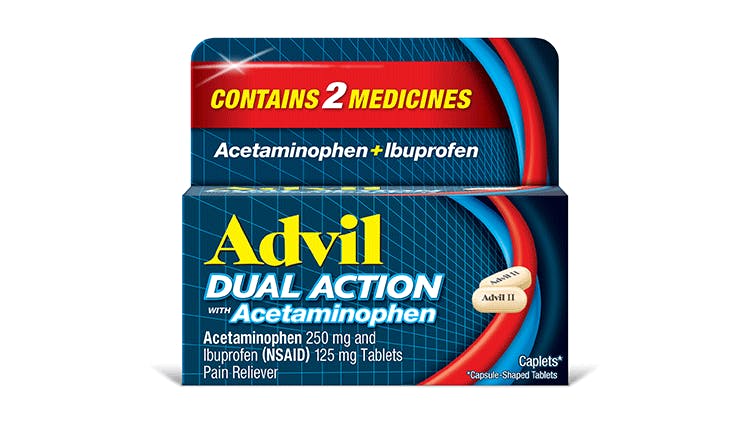
Advil Dual Action
Explore Advil Dual Action, an effective combination of ibuprofen and acetaminophen that fights pain in 2 ways.

What are the signs of musculoskeletal pain?
Learn more about the common signs and symptoms of musculoskeletal pain.

Patient Resources
Access educational resources to share with your patients to help them have a better understanding of their pain condition.
