Allergy and hayfever symptoms & management

Woman blowing her nose

Helping patients to manage the symptoms of hayfever

The symptoms of hayfever (or allergic rhinitis) may be seasonal but can have a wide-ranging impact on patients’ eyes, nose and even the skin.

The British Society for Allergy and Clinical Immunology have issued guidance for the management of allergic rhinitis.1

First line recommendations for hay fever management

Image of first line recommendation for allergies

Mild-to-moderate intermittent and mild persistent - Antihistamines

First line recommendations for mild symptoms according to national clinical treatment guidelines are antihistamines1,2

  • Effective on symptoms of itch, sneeze and rhinorrhea and have modest effects on nasal congestion
  • Improve histamine driven symptoms at sites other than the nose
  • Regular therapy is more effective than ‘as needed’ use in persistent rhinitis
Image of first line recommendation for allergies

Moderate to severe persistent - Topical INS

A first line recommendation for moderate/troublesome symptoms is topical intranasal corticosteroids (INS)1,2

  • Act by suppression of inflammation at multiple points in the inflammatory cascade

Woman smelling flowers

The role of INSs in the treatment of AR

INSs are recognised as the most effective class for controlling symptoms of long-term anti-inflammatory treatment for AR, as they:3,4

  • Relieve nasal symptoms
  • Are active in both early and late phases of the allergic cascade
  • High concentrations at receptor sites are achieved with a single dose

According to the 2008 Rhinitis Updated Practice Parameter from the AAAAI, INSs are the most effective first-line medication class for controlling symptoms of AR.3

In the treatment of SAR, INSs have been shown to be more effective than the combined use of an antihistamine and a leukotriene (LT) antagonist.3

INSs may provide significant symptom relief for patients with SAR, whether they’re used on a regular basis or on an as-needed basis.3

Woman playing with dog

Advice on how to avoid allergies

In addition to oral antihistamines and intranasal corticosteroids, first‐line treatment for allergies also involves the avoidance of triggers that may cause an allergic reaction.5

Avoidance strategies for allergic rhinitis include:5

  • The use of allergen‐impermeable covers for bedding
  • Keeping relative humidity in the home below 50% to inhibit mite growth
  • Reducing pollen exposure by keeping windows closed, using air conditioning, and limiting the amount of time spent outside during peak pollen season
  • Avoiding exposure to, or ownership of, pets

Clinician and patient

Allergy management: in summary

Although each treatment option will help to reduce a person’s AR symptoms, clinicians should tailor the treatment option. Each of the following are common clinical scenarios, which would have different considerations:6

  1. Person with nasal congestion as the primary complaint
  2. Person with intermittent or episodic nasal AR symptoms
  3. Person with mild AR symptoms
  4. Person with moderate to severe AR symptoms
  • Product Information - Pirinase Allergy

    Full information can be found in the Summary of Product Characteristics.

    Pirinase Allergy 0.05% w/w Nasal Spray (fluticasone propionate). Uses: Prevention and treatment of allergic rhinitis. Dosage and method of use: Adults, elderly and adolescents aged 12 years and over: Two sprays into each nostril once a day, preferably morning. Twice a day may be required in some cases. Maintenance: one spray per nostril once a day if possible. Use lowest possible maintenance dose. Max 4 sprays a day in each nostril. Children under 12 years: Not to be used. Contraindications: Hypersensitivity to ingredients. Concomitant use with HIV medicines. Precautions: Stop treatment or seek medical advice if improvement is not seen within 7 days. Seek medical advice if relief is inadequate, or if more than 3 months continuous use is required. Abnormally heavy challenge of summer allergens may in certain instances necessitate appropriate additional therapy. Seek medical advice before use with: other corticosteroid products, fever, nasal/sinus infection (treat appropriately), recent nasal injury/surgery, nasal ulceration. Caution due to interactions with cytochrome P450 3A4 inhibitors may increase systemic exposure to fluticasone. Caution commencing in those withdrawing from systemic steroids, and commencing therapy with intranasal fluticasone propionate, particularly if impairment of adrenal function suspected. Treatment with higher than recommended doses of nasal corticosteroids may result in clinically significant adrenal suppression. If there is evidence of higher than recommended doses being used, then additional systemic corticosteroid cover should be considered during periods of stress or elective surgery. Systemic effects of nasal corticosteroids may occur, particularly at high doses prescribed for prolonged periods. These may include Cushing's syndrome, Cushingoid features, adrenal suppression, growth retardation in children and adolescents, cataract, glaucoma and more rarely, a range of psychological or behavioural effects including psychomotor hyperactivity, sleep disorders, anxiety, depression or aggression (particularly in children). May cause visual disturbance. Blurred vision or other visual disturbances should be considered for referral to an ophthalmologist for evaluation. Contains benzalkonium chloride which may cause bronchospasm. Side effects: Very Common: epistaxis. Common: Dryness and irritation of the nose and throat, unpleasant taste and smell, headache. See SPC for full details. Legal category: P. PL number: PL 44673/0099. Product licence holder: Haleon UK Trading Limited, The Heights, Weybridge, Surrey, KT13 0NY, UK. Package quantity and MRSP (excl. VAT): 60 sprays £8.32; 120 sprays £12.37. Date of last revision: Feb 2026.

  • Product information – Piriton Syrup and Piriton Allergy Tablets

    Full information can be found in the Summary of Product Characteristics.

    Piriton Children’s Allergy Syrup and Piriton Allergy Tablets (chlorphenamine maleate) Indications: Symptomatic relief of allergic conditions including hay fever. Symptomatic relief of itch associated with chickenpox. Dosage and method of use: Adults and children 12 years and over: 10ml or 1 tablet (4mg) 4-6 hourly. Max 60ml or 6 tablets (24mg) in any 24 hours. Elderly: Lower dose should be considered. Children 6-12 years: 5 ml or 1/2 tablet (2mg) 4-6 hourly. Max 30ml or 3 tablets (12mg) in any 24 hours. Syrup only: Children 2-6 years: 2.5 ml (1 mg) 4-6 hourly. Max 15ml (6 mg) in any 24 hours. Children 1-2 years: 2.5 ml (1 mg), twice daily. Max 5ml (2 mg) in any 24 hours. Piriton Allergy Tablets not recommended for children under 6 years, and Piriton Syrup not recommended for children below 1 year. Do not use either product continuously for more than two weeks without consulting a doctor. Contraindications: Hypersensitivity to antihistamines or the product ingredients. Treatment with MAOIs within last 14 days. Warnings and Precautions: Avoid concurrent use with other antihistamines and alcohol. May seriously affect ability to drive and use machinery. Caution in patients with: enlarged prostate, severe hypertension or cardiovascular disease, hepatic or renal impairment, epilepsy, raised intraocular pressure, bronchitis, bronchiectasis and asthma. Children and elderly more likely to experience neurological anticholinergic effects and paradoxical excitation. Avoid use in elderly patients with confusion. Avoid concurrent use with drugs which cause sedation. Those with fructose or galactose intolerance, Lapp lactase deficiency, glucose-galactose malabsorption or sucrose-isomaltase insufficiency should not take these medicines. Syrup: Contains sucrose (should be considered in those with diabetes mellitus, ensure adequate dental hygiene is maintained), hydroxybenzoates (E218, E214, E216) which may cause allergic reactions (possibly delayed), and ethanol (6.3% v/v) (should be considered in those suffering from alcoholism and other high-risk groups). Side effects: Very common: Sedation, somnolence. Common: Fatigue, disturbance in attention, abnormal coordination, dizziness, headache, blurred vision, nausea, dry mouth. See SPC for full details. Legal category: P. PL numbers: Syrup: PL 44673/0094. Tablets: PL 44673/0093. Product licence holder: Haleon UK Trading Limited, The Heights, Weybridge, Surrey, KT13 0NY, UK. Package quantity and RSP (excl. VAT): Syrup: 150 ml £6.04. Tablets: 30s £5.42, 60s £8.75. Date of last revision: Jan 2026

  • Product Information – Piriteze

    Full information can be found in the Summary of Product Characteristics.

    Piriteze Hayfever & Allergy 10mg Film Coated Tablets, Piriteze Children's Hayfever & Allergy 1mg/ml Syrup (GSL)and Piriteze Children's Hayfever & Allergy 1mg/ml Syrup (P) (cetirizine hydrochloride). Indication: Symptomatic treatment of seasonal and perennial allergic rhinitis, and chronic idiopathic urticaria. Dosage and method of use: Adults and adolescents over 12 years: 10 mg once daily. Children 6-12 years: 5 mg twice daily. Elderly: As adults if renal function normal. Syrups only: Children 2 to 6 years: 2.5mg twice daily. Tablets not recommended for children under 6 years and syrups not recommended for children under 2 years. Adjust dose in moderate to severe renal impairment. See SPC for details. Contraindications: Hypersensitivity to ingredients, hydroxyzine, piperazine derivatives or severe renal impairment (creatinine clearance <10 ml/min). Warnings and Precautions: Concomitant alcohol. Predisposition factors of urinary retention (e.g. spinal cord lesion, prostatic hyperplasia). Epilepsy/risk of convulsions. Pruritus and/or urticaria may occur when cetirizine stopped, may require treatment to be restarted. Allergy skin tests are inhibited by antihistamines, a wash out period (3 days) is required before performing them. Tablets: Not suitable for those with galactose intolerance, Lapp lactase deficiency or glucosegalactose malabsorption. Syrup: Not to be taken by those with fructose intolerance. Contains methyl and propyl parahydroxybenzoate which may cause allergic reactions (possibly delayed). Side effects: Uncommon: Agitation, paraesthesia, diarrhoea, pruritus, rash, asthenia, malaise. All other side effects are rare, very rare or have an unknown frequency see SPC for full details. Legal category: GSL: Syrup and Tablets: 70ml/ 7, 14, 30 P: Syrup: 70ml. PL numbers: Tablets: PL 44673/0097. Syrup (GSL): PL 44673/0095. Syrup (P): PL 44673/0096. Product licence holder: Haleon UK Trading Limited, The Heights, Weybridge, Surrey, KT13 0NY, United Kingdom Package quantity and RSP (excl. VAT): Tablets: 7s £4.16, 14s £6.66, 30s £9.16. Syrup (GSL): 70 ml £5.41. Syrup (P): 70ml £5.41 Date of last revision: January 2026

  • Product Information - Pirinase Hayfever

    Full information can be found in the Summary of Product Characteristics.

    Pirinase Hayfever Once Daily 0.05% Nasal Spray (fluticasone propionate). Indications: Treatment of seasonal allergic rhinitis. Dosage and method of use: Adults: Two sprays into each nostril once a day, preferably in the morning. Maintenance: one spray per nostril once a day, if symptoms recur the dosage may be increased accordingly. Use lowest possible maintenance dose. Max 2 sprays a day in each nostril. Children under 18 years: Not to be used. Contraindications: Hypersensitivity to ingredients. Concomitant use with HIV medicines. Warnings & Precautions: Stop treatment or seek advice if an improvement is not seen within 7 days. Seek medical advice if relief is inadequate after 7 days or more than 1-month continuous use is required. Seek medical advice before use with: other corticosteroids, nasal/sinus infection, recent nasal injury/surgery, nasal ulceration. Caution due to interactions with potent cytochrome P450 3A4 inhibitors which may increase systemic exposure to fluticasone. Treatment with higher than recommended doses of nasal corticosteroids may result in clinically significant adrenal suppression. If there is evidence of higher than recommended doses being used, then additional systemic corticosteroid cover should be considered during periods of stress or elective surgery. Systemic effects of nasal corticosteroids may occur, particularly at high doses prescribed for prolonged periods. May cause visual disturbance. Blurred vision or other visual disturbances should be considered for referral to an ophthalmologist for evaluation. Contains benzalkonium chloride which may cause bronchospasm. Side effects: See SPC for full details. Very Common: Epistaxis. Common: Headache, unpleasant taste and smell, dryness and irritation of the nose and throat. Legal category: GSL. Product licence number: PL 44673/0100. MAH: Haleon UK Trading Limited, The Heights, Weybridge, Surrey, KT13 0NY, UK. RRP (excl. VAT): 60 sprays £8.32. Text prepared: Jan 2026.

Piri – the UK’s No 1 Allergy Care Range7

Respiratory webinars

Respiratory Webinars

Access our webinar series.

Watch now

Learning lab icon

Learning Lab

Find out more in the learning lab.

Find out more

Patient resources icon

Patient care resources

Download resources for your patients.

Find out more

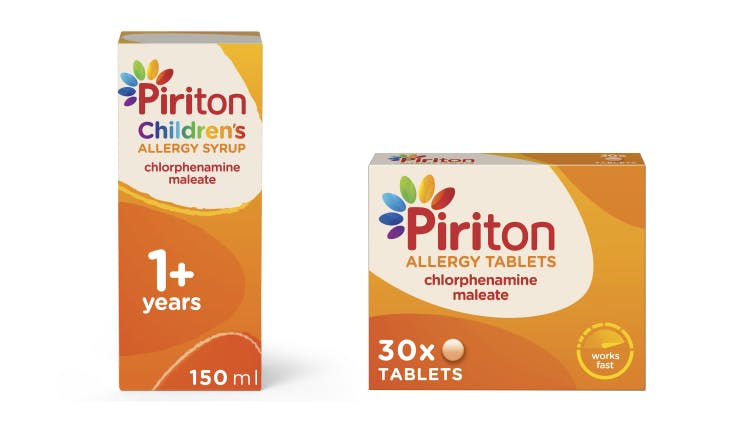
Pack shot of Piriton Syrup and Piriton Tablets

Piriton Children’s Allergy Syrup and Piriton Allergy Tablets (chlorphenamine maleate)

Find out more about Piriton Syrup suitable from 12 months and Piriton Tablets suitable from 6 years.
Learn more & PI

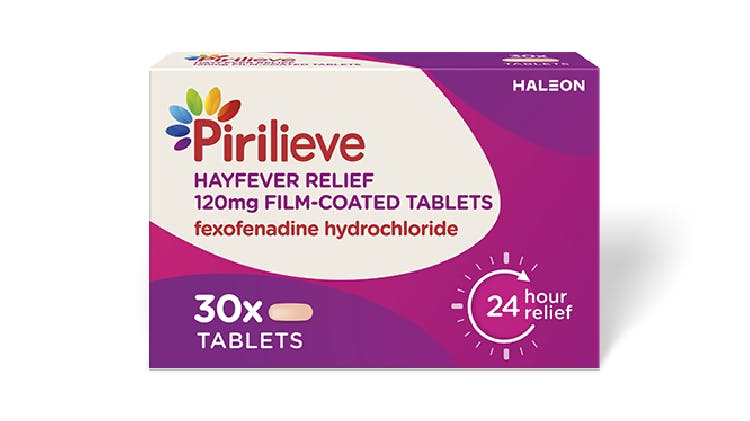
Image of Pirilieve Hayfever Relief pack with 30 tablets (fexofenadine hydrochloride)

Pirilieve Hayfever Relief 120mg Film-coated Tablets (fexofenadine hydrochloride)

Prescription strength relief of hayfever symptoms.
Learn more & PI

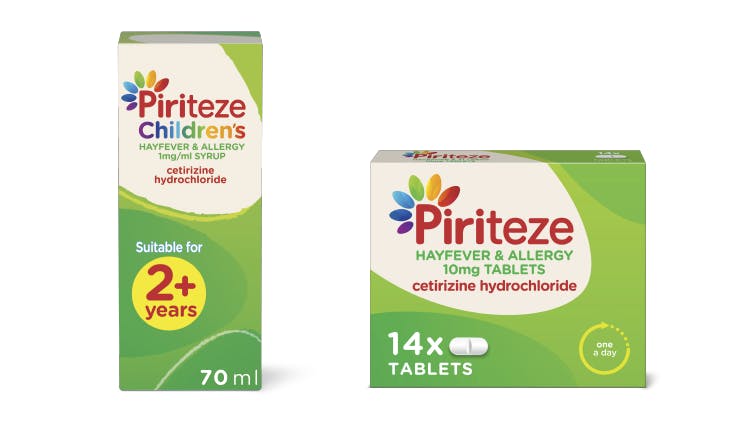
Image of Piri logo

Piriteze Hayfever & Allergy 10mg Film Coated Tablets, Piriteze Children's Hayfever & Allergy 1mg/ml Syrup (P) (cetirizine hydrochloride)

Find out more about Piriteze Syrup suitable from 2 years and Piriteze tablets suitable from 6 years.

Learn more & PI