Back pain: Management

Woman holding back

Managing back pain

Back pain frequently resolves within a few weeks or months.1,2

However, sometimes the pain can persist over the long term, or keep recurring.1

Here we review physiotherapeutic and pharmacological treatment options to help your patients manage their back pain.

Guideline recommendations for treating back pain
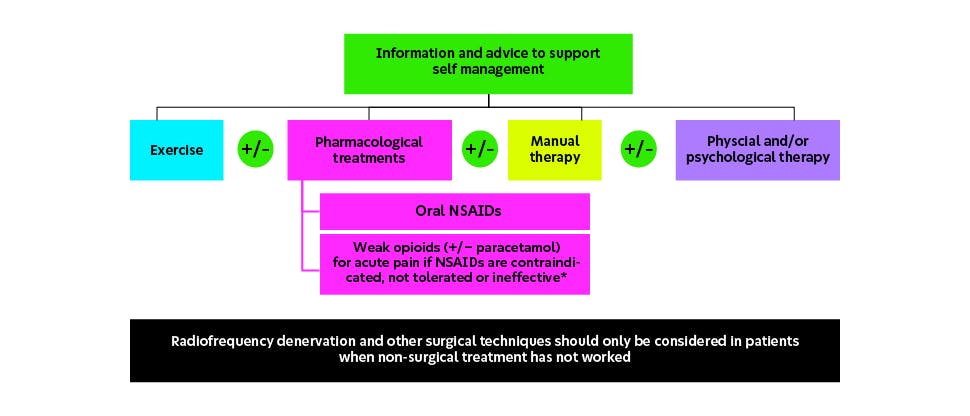
Graphic summarising treatment pathway for back pain

Guidance on managing back pain recommends multimodal intervention

Recommendations from the National Institute for Health and Care (NICE) are available guiding the pharmacological and non-pharmacological management of lower back pain.3

This advice covers several modes of intervention:

  • Exercise
  • Pharmacological treatments
  • Manual therapy
  • Physical and/or psychological therapy
  • Exercise

    Encourage the person to keep active, resume normal activities and return to work/study as soon as possible.4

    Certain forms of exercise can relieve pain and improve function as part of a multidisciplinary rehabilitation approach.2,4

    Walking, swimming, yoga and pilates are activities that may be particularly helpful for back pain.4

    Specific exercises and stretches are also available for relieving back pain.2

  • Pharmacological treatments

    NICE guidance recommends that oral non-steroidal anti-inflammatory drugs (NSAIDs) are considered for managing lower back pain.4

    Weak opioids with or without paracetamol may be considered for acute lower back pain but only if NSAIDs are contraindicated, not tolerated or ineffective.4

  • Manual / physical therapy

    Manual therapies, which involve massage and manipulating the spine, can be considered as part of a treatment package that also includes exercise.4

    Manual therapy can be provided by physiotherapists, chiropractors or osteopaths.

  • Psychological therapy

    Psychological interventions such as cognitive behavioural therapy can be helpful for coping with the pain, as part of a treatment approach that also includes manual therapy and exercise.4 This should be considered if the person has significant psychosocial barriers to recovery or other treatments are ineffective.4

How can Laura and Riya be helped?

Woman with child

Laura

Laura has recently hurt her back and cannot do as much with her family as she used to. She is having difficulty bending, twisting and reaching.

Laura needs a solution that offers powerful relief from back pain.

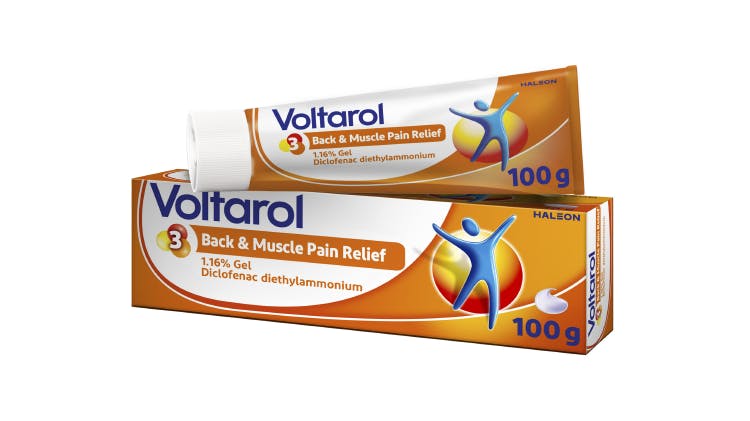
Voltarol Back and Muscle Pain Relief 1.16% Gel is scientifically proven to help relieve pain, reduce inflammation and restore movement.

Find out more

Understanding back pain

Magnifying glass icon

Causes

Find out about the causes of back and neck pain.

Find out more

Signs and symptoms icon

Signs and symptoms

Explore an overview of how to recognise back and pain and know when to refer patients.
Find out more

Sprains and strains icon

Overview of sprains and strains

Find out about how prevalent sprains and strains are, and meet two patients with these problems.

Find out more

Learn more

Voltarol Back & Muscle Pain Relief 1.16% Gel

Voltarol Back & Muscle Pain Relief 1.16% Gel Diclofenac Diethylammonium for back pain

Scientifically proven to help relieve pain, reduce inflammation and help restore movement.
Learn more & PI

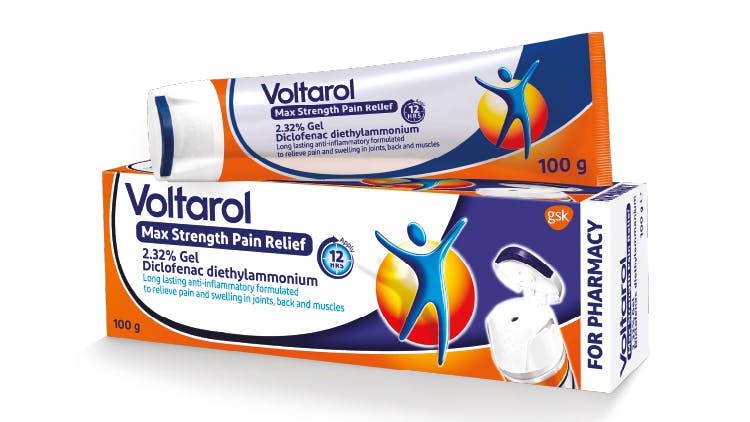
Voltarol Max Strength Pain Relief 2.32% Gel

Voltarol Max Strength Pain Relief 2.32% Gel (diclofenac diethylammonium) offers convenient twice daily application
Learn more & PI

Patient care resources icon

Patient care resources

Access patient care resources.

Learn more